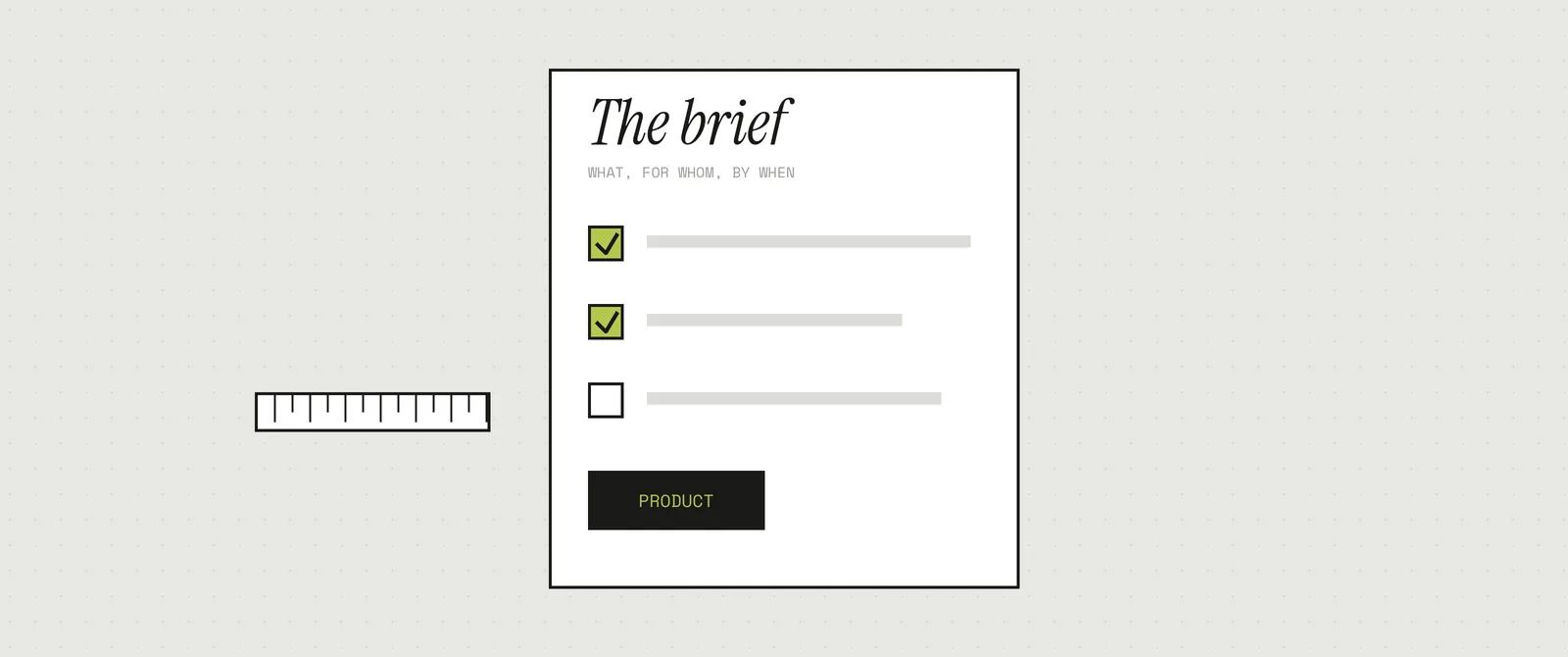
Before you approve any ad spend, hire a freelancer or give a teammate two weeks for a campaign, you should be able to read one page and know what the work is for, who it is aimed at and how you will judge it. That page is the brief. If nobody can fill it in, the campaign is not ready, however good the first designs look.
A brief is short on purpose. Writing it forces the decisions that otherwise get made halfway through, usually by whoever is closest to the deadline. Below are the sections it needs, a filled example for a hypothetical business, and the questions worth asking before you sign it off.
The sections
Objective
One sentence that describes the business result you want, with a number and a date. "Raise awareness" does not work as an objective, because nobody can tell when it has been reached. "Get 40 paid bookings for the new service by the end of March" does.
If you find yourself writing two objectives, you probably have two briefs.
Audience
Who exactly you want to reach, described by their situation rather than demographics, and what they believe today. Include the one or two things that would stop them from acting. The more precisely you describe this group, the easier every other section becomes.
Message
The single idea you want the audience to take away, written as a sentence a person might actually repeat. Add the supporting points that make it believable. If the message needs a paragraph to explain, it is not ready yet.
Offer
What you are asking people to do, and what they get for doing it: a first-order discount, a free trial, a sample, a bundle. Be specific about the terms, including when the offer ends and anything it excludes. A clear message paired with a vague offer tends to collect attention and very few customers.
Channels
Where the audience will actually see this, and why those places. Pick fewer channels than feels comfortable. Two channels done properly will teach you more than five done thinly, because each one will produce enough results to read.
Budget
The total amount of money and the time it will take, including people's hours. Split the money by channel and keep a small part in reserve for whatever is working halfway through. Write down the point at which you will stop spending if nothing is happening.
Deadline
The launch date, the end date, and the date you will review results. Add any fixed dates the campaign depends on, such as a product being in stock or a landing page being finished.
How success is measured
The number that decides whether this worked, where it will be measured and who will report it. Add one or two supporting numbers that help explain the result, such as cost per booking or the share of visitors who started the booking form. Agree on all of this before launch. Choosing the measure after the results arrive makes almost any campaign look fine.
A filled example
Say you run a hypothetical neighborhood bike repair shop and want to launch a mobile service: a mechanic comes to the customer's office and fixes the bike while they work. Here is what the brief might look like.
| Section | What the brief says |
|---|---|
| Objective | 40 paid mobile repair bookings between March 3 and April 13 |
| Audience | People who commute by bike to offices within three miles of the shop, who know their bike needs work but cannot spare a Saturday to drop it off |
| Message | Your bike gets serviced while you are at your desk. Supporting points: same prices as the in-store menu, the mechanic carries parts for common repairs, booking takes a minute online |
| Offer | No travel fee on the first booking until April 13, standard service prices otherwise |
| Channels | Flyers and a Tuesday morning lobby stand at partner office buildings, plus local search ads limited to the service area |
| Budget | $2,500 in total: $1,800 for search ads, $400 for printing, $300 held in reserve. About four hours a week of the owner's time |
| Deadline | Booking page live February 24, campaign runs March 3 to April 13, review on April 16 |
| Success measure | Paid bookings recorded in the booking system. Supporting numbers: cost per booking, and how many first-time customers book a second service |
Notice how much the example rules out. It does not try to reach families, weekend riders or people who live outside the area. That is a choice, and because it is written down, nobody quietly widens it in week two when bookings are slow.
Notice also what it leaves out: there are no slogans, no color choices and no list of ad variations. Those come later, from whoever does the creative work, and they are easier to judge once the brief exists.
Questions to ask before you approve it
Read the brief as if your own money is on the line, because it usually is. Then work through these:
- If the objective is hit, would it matter to the business, and would missing it change any plans?
- Could someone in the audience read the message and repeat it back in their own words?
- Is the offer something this audience would actually want, or something that was easy to set up?
- Why these channels, and has anyone checked that the audience is really there?
- What happens if the first two weeks show nothing? Is there a stop point and a reserve?
- Are the dependencies on schedule, such as pages, stock and approvals?
- Who reports the result, from which system, and on what date?
- Is there anything in the brief that two people on the team would read differently?
If any answer is "not sure", send the brief back with that question attached. A brief that takes another day to fix costs far less than a campaign that runs for six weeks without a clear target.
Where to start
- Pick one campaign you are planning for the next month.
- Fill in the eight sections in plain sentences, on one page at most.
- Hold off on creative work until the brief is approved.
- Go through the approval questions with whoever will run the work.
- Put the review date in the calendar before launch, not after.